Pure3D
An Infrastructure for the Publication and Preservation of 3D Scholarship
“PURE3D is a national infrastructure dedicated to the publication and preservation of 3D scholarship, spearheaded by Dr. Costas Papadopoulos and Prof. Susan Schreibman at Maastricht University, The Netherlands. The project aims to redefine how 3D cultural heritage and scholarly outputs are presented, preserved, and evaluated, fostering innovation in 3D-based research across the humanities and social sciences.”
Visit PURE3Dpure3d.euMain Researchers: Prof. dr. Susan Schreibman, Dr. Costas Papadopoulos
Website: pure3d.eu
Infrastructure: editions.pure3d.eu
PURE3D is a national digital‑infrastructure initiative that redefines how 3D cultural‑heritage research is created, published, and preserved. Developed at Maastricht University and funded by the Dutch Platform Digitale Infrastructuur – Social Sciences & Humanities (PDI‑SSH), the project introduces a new paradigm for 3D scholarship by treating 3D models not as isolated visualizations but as 3D Scholarly Editions—rich, contextualized research objects that integrate annotations, multimedia sources, paradata, and interpretive frameworks.
Project Description
PURE3D is a national digital‑infrastructure initiative that redefines how 3D cultural‑heritage research is created, published, and preserved. Developed at Maastricht University and funded by the Dutch Platform Digitale Infrastructuur – Social Sciences & Humanities (PDI‑SSH), the project introduces a new paradigm for 3D scholarship by treating 3D models not as isolated visualizations but as 3D Scholarly Editions—rich, contextualized research objects that integrate annotations, multimedia sources, paradata, and interpretive frameworks.
At its core, PURE3D provides a robust online environment where researchers, educators, and cultural‑heritage institutions can publish interactive 3D content in a sustainable, FAIR‑aligned format. The infrastructure supports the long‑term preservation of 3D models, enables transparent documentation of their creation, and offers tools for embedding historical, archaeological, and artistic context directly within the 3D environment. By elevating 3D models into fully citable scholarly resources, PURE3D strengthens methodological rigor in digital heritage and opens new pathways for public engagement, interdisciplinary research, and the future of virtual cultural heritage.
Contribution
My contribution towards Pure3D was somewhat broad, covering both conceptual as well as more practical work. More specifically, my involvement took place within three areas: Narrative Design of web 3D experiences (or Scholarly Editions), 3D Design for and with stakeholders and participants, and UX Design on the infrastructure itself, and to improve the functionality and accessibility of the underlying web app, Voyager Story.
Narrative Design
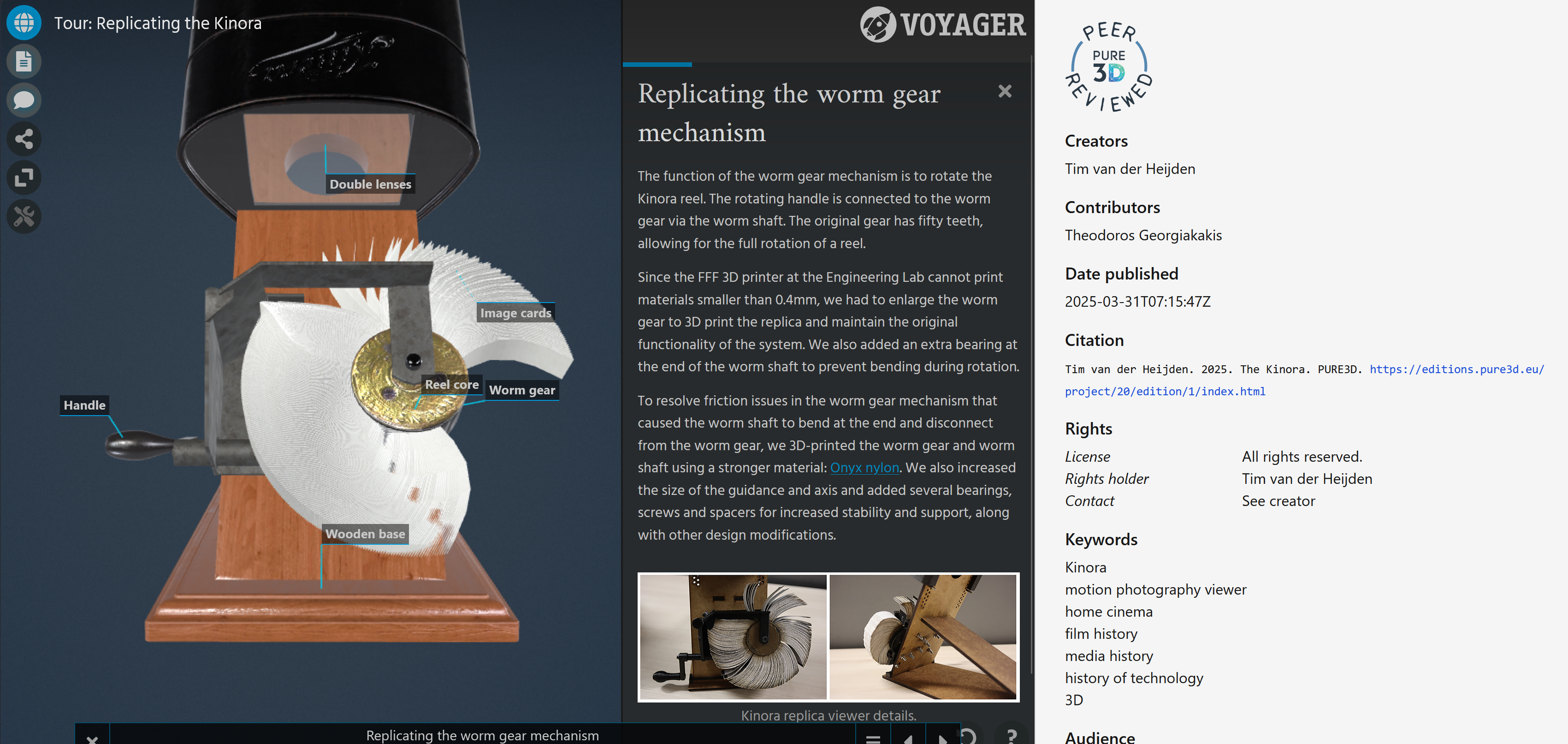
For the narrative design, I was tasked to ideate and develop 3D web experiences, called Scholarly Editions, which utilize 3D models embellished with text and multimedia, in a curated academic manner, to narrate the multi-faceted histories of cultural artifacts. I assisted in the development of two editions in Voyager Story: (1) “Maarten van Bommel op Bank” for the Museum van Bommel van Dam and (2) “A Genealogy of Home Cinema” for the Open University of the Netherlands.
3D Design
For this part, I had to work collaboratively together with stakeholders (typically local cultural institutions) and project participants (academic professors), towards the digitization of culturally significant objects, and to then edit them with the aim to improve the 3D datasets for use in the infrastructure’s editions or experiences. For the digitization of objects photogrammetry was used, together with some reconstruction elements, to improve performance of the 3D objects in the web. Similar improvements and other corrections were implemented on the models that the participants brought, to render them suitable and properly optimized for web 3D, and the three.js-based web app.
UI/UX Design
Since the project itself utilizes the main UX design framework, Design Thinking, as its theoretical framework, I took part in numerous UX design & research activities. The UX research process included moderated usability testing sessions, focus group discussions, and a series of co‑design and ideation workshops. During these workshops, the project participants engaged in brainstorming activities and affinity mapping exercises, using post‑it notes to generate, categorize, and prioritize ideas for the cultural infrastructure and its embedded web application.
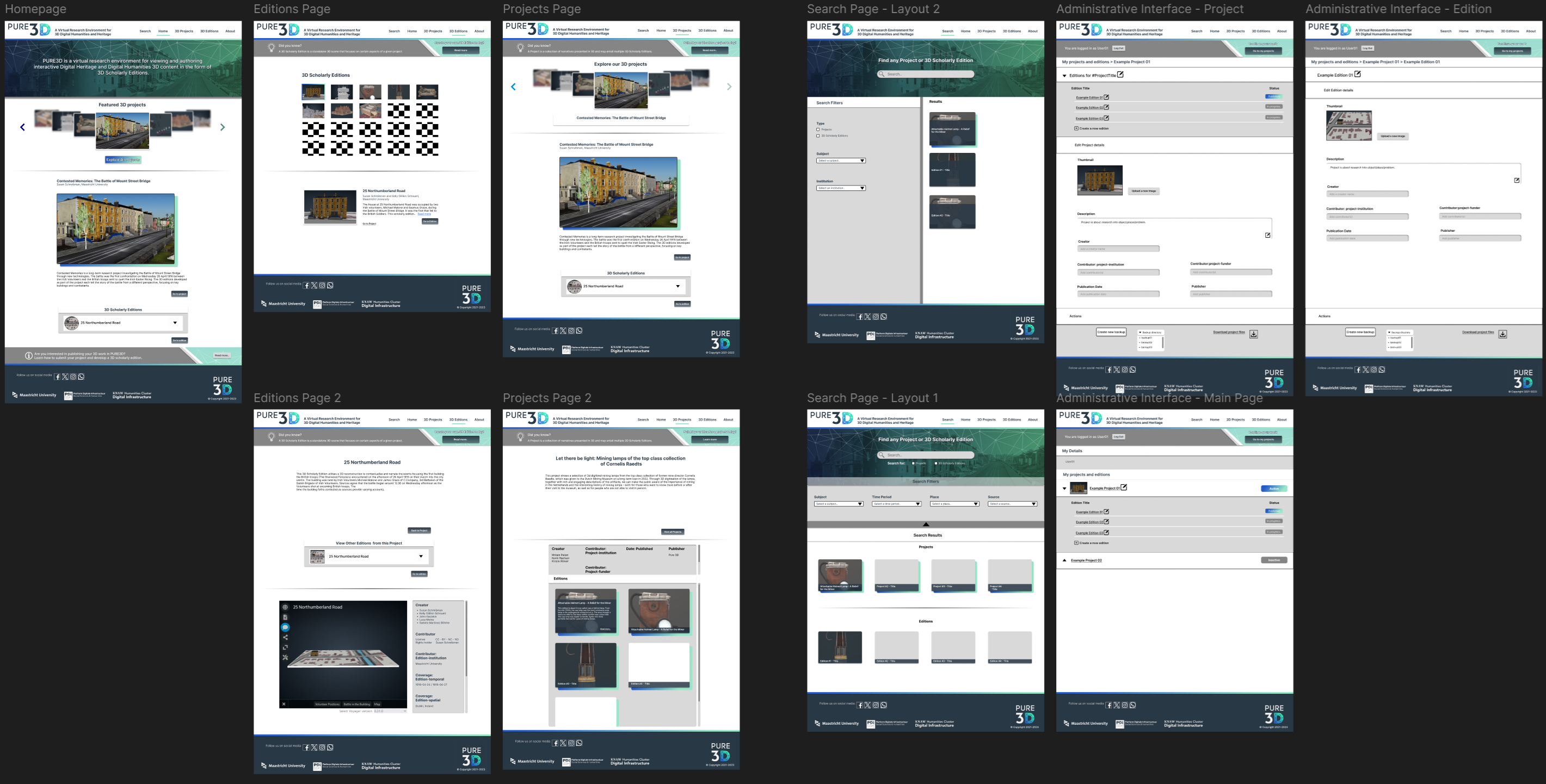
For the UX Design part, my contribution to the project was in two main areas. First, I was responsible for creating the wireframes of the infrastructure’s website, both for the front-end (end-user level) and for the back-end (editions publishing system).
Second, I was tasked to work with the developer of the underlying web app, Voyager Story, in order to ideate a tutorial layer, that makes it more intuitive and accessible to use, for both the participants and the public. This need arises because Voyager Story is a 3D visualizer and digital storytelling tool, a format that many participants—including academic professors and members of the general public—are not necessarily familiar with.
Promotional Content
Right before the launch of the infrastructure, I was tasked to editing audio-visual media content, to be published as promotional content for the platform. First, I co-created and edited a podcast on digital cultural heritage, composed the music for the opening and closing of the session, as well as normalized, mixed and mastered the voices of the participants.
Second, I was in charge of editing 3 testimonial videos of the participants talking about the infrastructure, during a montage showcasing each participant’s respective 3D edition.
Visit the PURE3D website at pure3d.eu.
Explore the infrastructure at editions.pure3d.eu.